Lisbon Self-Guided Walking Tour: Route, Timing And When A Guide Is Worth It
Lisbon is compact enough to walk in a day and hilly enough to regret trying. Here is a route that works on foot, what it costs, where it gets hard, and the point at which a guided walk pays for itself.
Short answer
A self-guided loop from Baixa through Chiado and up into Alfama covers roughly 4 to 6 km at a slow sightseeing pace and fills 4 to 5 hours. Budget about 1.90 EUR per single transit ticket, 5 EUR for the Museu do Fado if you add it, and nothing for the viewpoints. A guided walk from 19 EUR per person makes sense when you want history context without reading a phone.
Lisbon's historic core is one of the few European capitals you can genuinely cross on foot in an afternoon. The walk from Commerce Square to the Castle of Sao Jorge viewpoint is under 2 km as the crow flies. The catch is the vertical: the same short hop climbs more than 100 metres, and the city's famous funiculars are not currently an escape hatch, with the Gloria, Bica and Lavra funiculars and the Santa Justa lift closed to passengers while the Graca funicular runs again, so check Carris for the current status. This guide lays out a realistic route through Baixa, Chiado and Alfama, prices every stop, and marks the exact points where the three-hour Rossio, Chiado and Alfama guided walk or an e-bike tour starts to look like the smarter buy rather than an indulgence (see Lisbon to Porto Day Trip).
What Does A Classic Self-Guided Lisbon Walking Route Look Like?
The classic route is a loop: start at Commerce Square, walk north through Baixa's grid to Rossio, climb into Chiado, cross to the Bairro Alto steps or head straight down to the Cathedral, then finish by winding up through Alfama to the castle walls. It needs no transit at all until your legs give out, and done slowly, with stops, it fills the better part of a day.
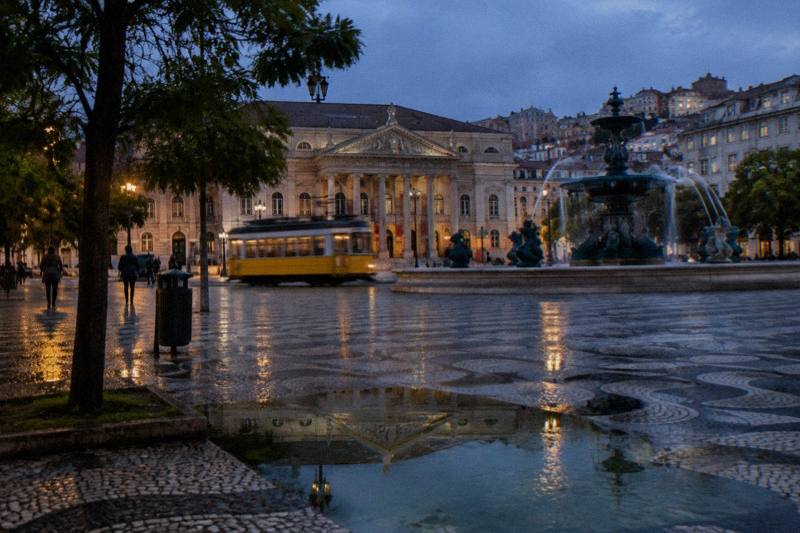
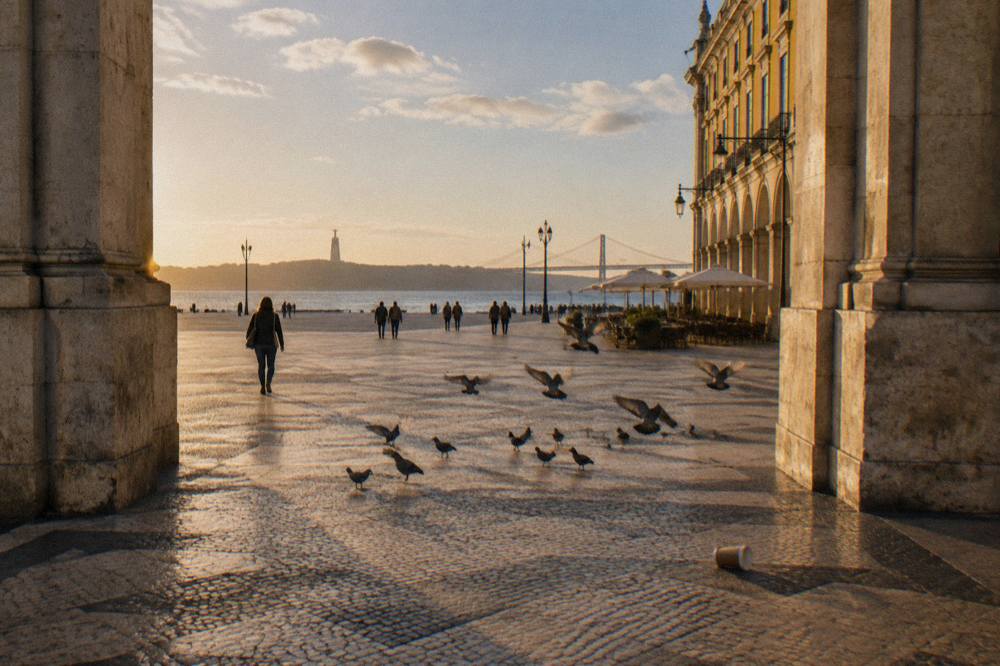
Commerce Square, the vast riverside plaza where the royal palace once stood, makes the easiest orientation point because every tram, bus and metro line in the city seems to pass within a block of it. From there, Rua Augusta runs dead straight through the triumphal arch into the heart of Baixa, the neighbourhood rebuilt in a grid after the great earthquake levelled it. This stretch is flat, wide and forgiving: a warm-up masquerading as sightseeing. Rossio square and its wavelike cobblestones sit at the top of it, with the Rossio train station facade, all horseshoe arches, as your backdrop.
Chiado begins the moment the ground tilts. Climb Garrett Street past the old bookshops and the cafe with the statue of Fernando Pessoa at its terrace table, and you are in the city's literary and shopping quarter. The Largo do Carmo square, with the ruined gothic convent open as a small garden, is the one genuinely quiet pause on the whole route. From there, the route splits: west into Bairro Alto's staircases, or east and downhill toward the Cathedral, where Alfama's tangle begins.
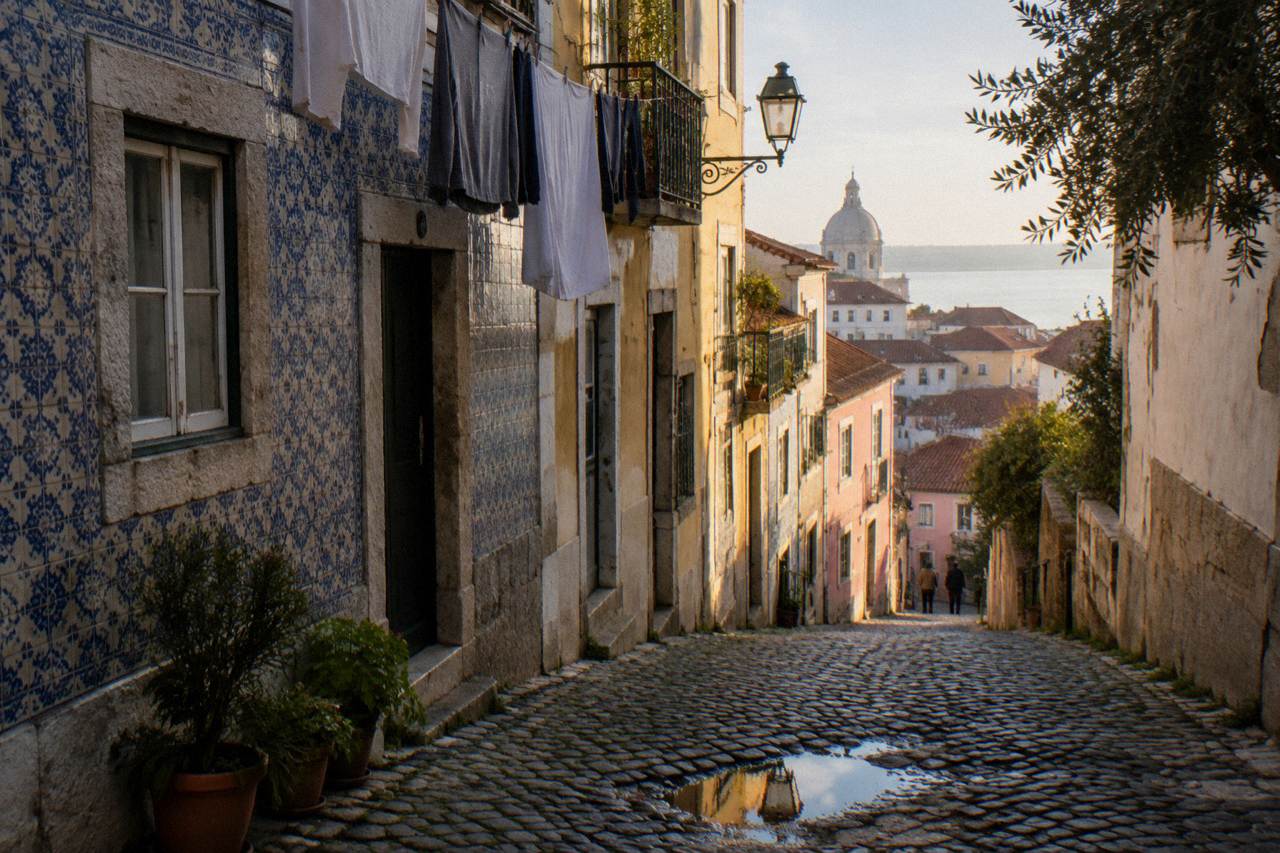
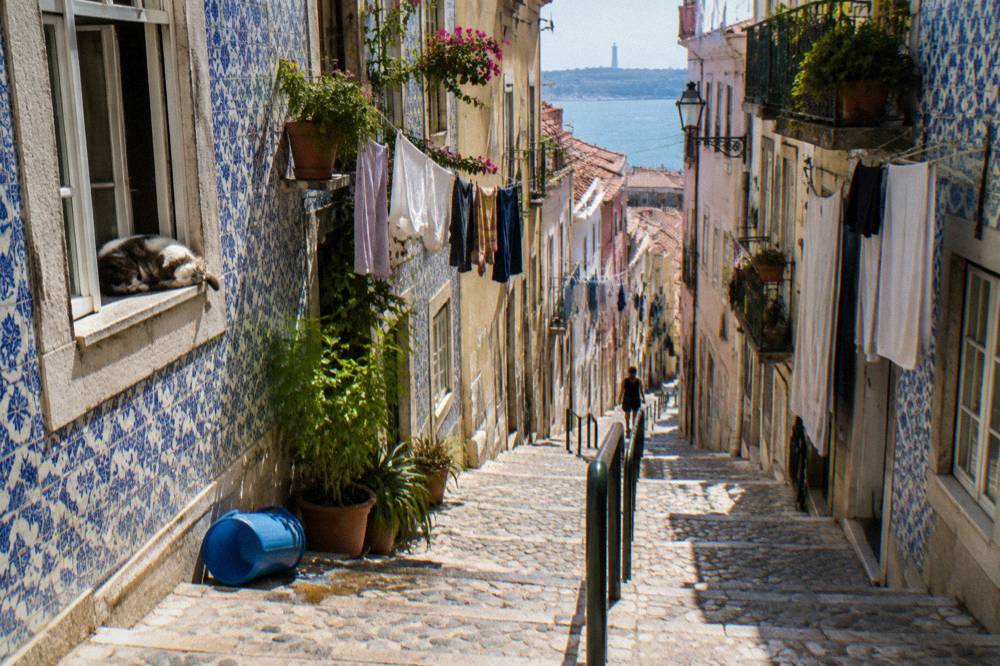
Alfama is where the self-guided plan either succeeds or collapses. It survived the great earthquake, so there is no grid, just lanes doubling back on themselves, laundry overhead and tiles at eye level. Give up on the map here and navigate uphill, loosely, toward the castle. The Portas do Sol terrace is the payoff: a full-width view over the Alfama rooftops to the river, free, and usually holding a couple of food carts. For a different angle at similar cost, the ride-to-compare logic in our guide to the Lisbon Portugal Tours roster applies: the same neighbourhood is covered by the three-hour small-group walk with a meal from 19 EUR, so the question is never whether Alfama is walkable, only whether you want a narrator for it.
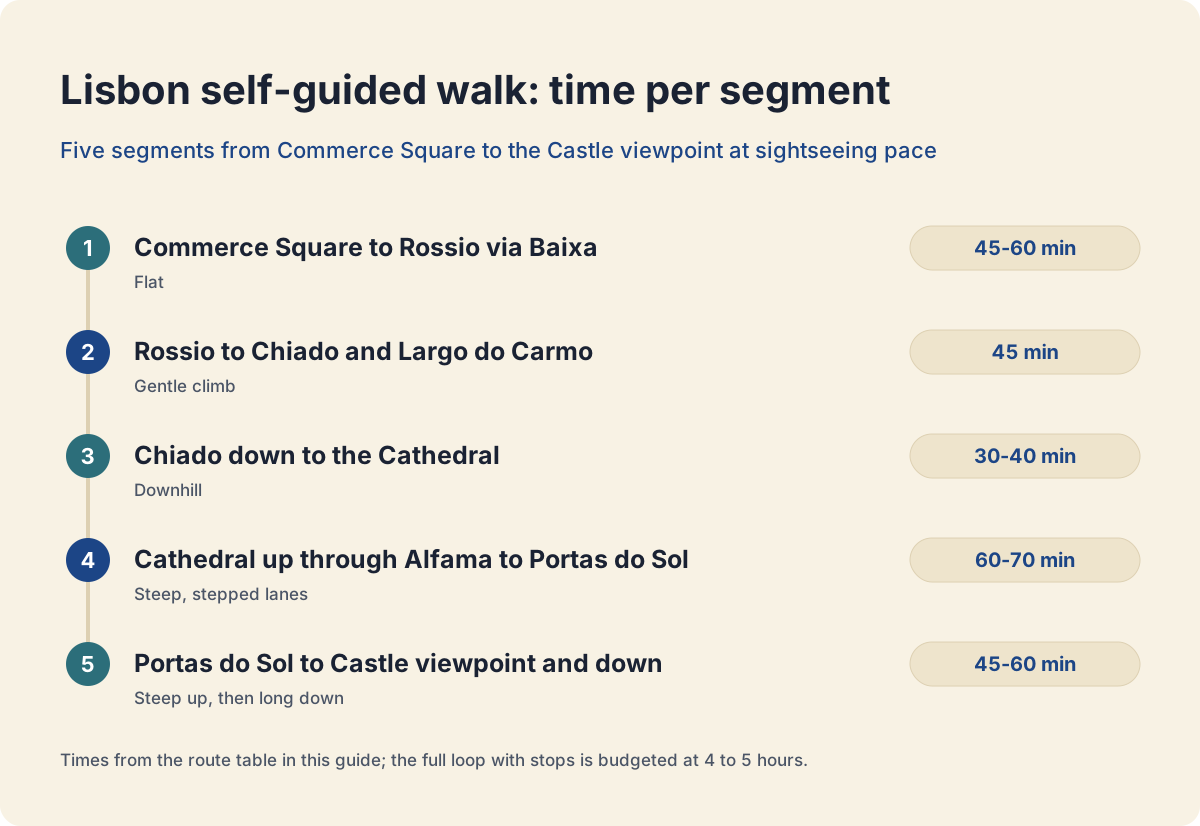
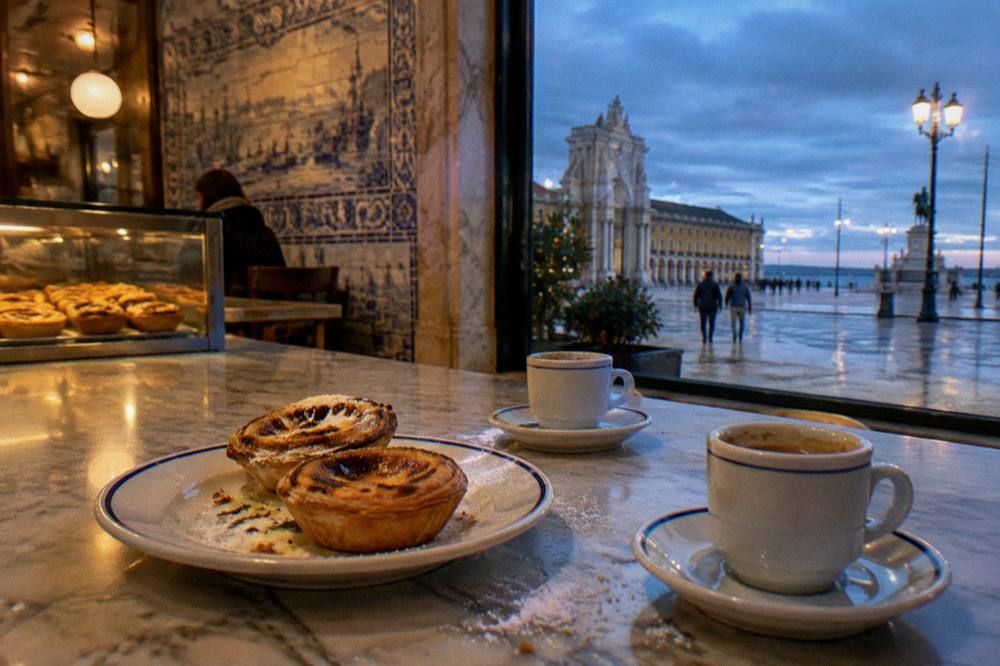
A note on pacing: the loop below assumes photo stops, one custard tart stop, and a proper pause at each terrace. Competitive walkers finish it in two hours and enjoy it far less.
| Segment | Terrain | Time at sightseeing pace |
|---|---|---|
| Commerce Square to Rossio via Baixa | Flat | 45-60 min |
| Rossio to Chiado and Largo do Carmo | Gentle climb | 45 min |
| Chiado down to the Cathedral | Downhill | 30-40 min |
| Cathedral up through Alfama to Portas do Sol | Steep, stepped lanes | 60-70 min |
| Portas do Sol to Castle viewpoint and down | Steep up, then long down | 45-60 min |
How Long Should You Budget, And When Should You Start?
Plan 4 to 5 hours for the full loop with stops, and start between 9:00 and 10:00. Starting early buys you empty lanes in Alfama before the tour groups arrive, a short queue at the custard tart counter, and daylight left for the Belem add-on afterwards. Start after 14:00 and you trade quiet lanes for golden light but meet the crowds head-on, and museums begin closing around 17:30 to 18:00.
The start time matters more in Lisbon than in flatter capitals because the punishing part of the route, the Alfama climb, lands at the end. An 09:00 start puts you at the foot of it around noon with fresh legs; a late lunch and a 15:00 start puts the same steps in front of you at the hottest, most crowded hour. One pastel de Belem costs about 1.50 EUR at the counter of the original house, which opens early and runs late, so it works as either a breakfast argument or an afternoon reward.
Transit is cheap and worth knowing even on a walking day. A Carris or Metro single ticket is 1.90 EUR, a 24 hour Carris/Metro pass is 7.25 EUR, and a ticket bought on board a tram costs 3.30 EUR, per the Carris price table. That last figure is the trap: hopping on the famous Tram 28E without a preloaded ticket nearly doubles the fare. Tram 28E runs its normal route, and it remains one of the better rescue options when the hills win, though pickpocket awareness on crowded trams is simple common sense here as in any busy capital. If you were hoping for a proper guided tram experience, our comparison of tram tour options in Lisbon explains what actually exists and what comes closest.
| Ticket | Price | When it helps a walker |
|---|---|---|
| Carris/Metro single | 1.90 EUR | One rescue ride when legs fail |
| 24h Carris/Metro pass | 7.25 EUR | Walking plus tram and metro hops all day |
| On-board tram ticket | 3.30 EUR | The expensive fallback, avoid if possible |
| Tram 28E | Runs on the normal network | Scenic shortcut up the Alfama side |
If a full walk plus transport plus museums is on your plan, the math behind the city pass is covered in detail in our Lisboa Card worth it breakdown, which weighs the 31 EUR 24 hour card against pay-as-you-go sightseeing.
For walkers who want the route but not the navigation, the guided alternatives cluster around the same geography, and the choice among them is really a choice of pace.
The three-hour Rossio, Chiado and Alfama walk from 22 EUR per person, rated 4.9 from 3,367 reviews, follows nearly the same loop described above with a meal stop included, so it works as either a replacement for the DIY route or a rehearsal run before you explore solo.
How Do You Handle The Hills When The Funiculars Are Closed?
Three of Lisbon's four funiculars, the Gloria, Bica and Lavra, plus the Santa Justa lift, are closed to passengers, while the Graca funicular runs again; check Carris for the current status. That removes the classic shortcuts up the Bairro Alto and Chiado slopes, so walkers should route around the hills, use the 28E tram or the metro's Baixa-Chiado station to skip climbs, and treat steps as part of the itinerary rather than an obstacle to power through.
The closures change route planning more than most guidebooks admit. The Santa Justa lift was the sanctioned way to rise from Baixa to Largo do Carmo without breaking stride; without it, the alternatives are the steep Calcada do Sacramento lane beside it, or a longer, gentler loop via Rossio and Garrett Street. The Bica funicular's absence matters less, since its famous half-hidden lower station is a photo stop rather than a transport necessity, but the Gloria's closure pushes the Bairro Alto climb entirely onto footpaths.
The practical workaround is vertical staging. Lisbon's metro runs underneath the walkable core, and the Baixa-Chiado station has an elevator bank that does the Santa Justa lift's job for the price of a 1.90 EUR single. For the Alfama ascent, Tram 28E grinds up the hill on rails while you ride, and the Graca funicular serves the eastern side of the same ridge. Between them, a walker can arrange to do almost every downhill segment on foot and skip the worst of the climbing, though a guide-based option like the max 14 Best of Lisbon small-group walk from 19 EUR, rated 4.9 from 5,542 reviews, has the advantage of a local who simply knows which lane flattens the hill.
The honest alternative for hill-averse walkers is electric assist. An e-bike converts the same loop from a calf workout into a glide, and the hills, Alfama and Mouraria tour by electric bike from 25 EUR, rated 4.8 from 3,859 reviews, covers the two steepest neighbourhoods in three hours with a maximum of 8 riders. That format is compared alongside the walking options in our bike tours overview, and the trade-off is simple: bikes beat steps, but lanes like Alfama's are narrow, and a slow walk still sees more tilework per metre.
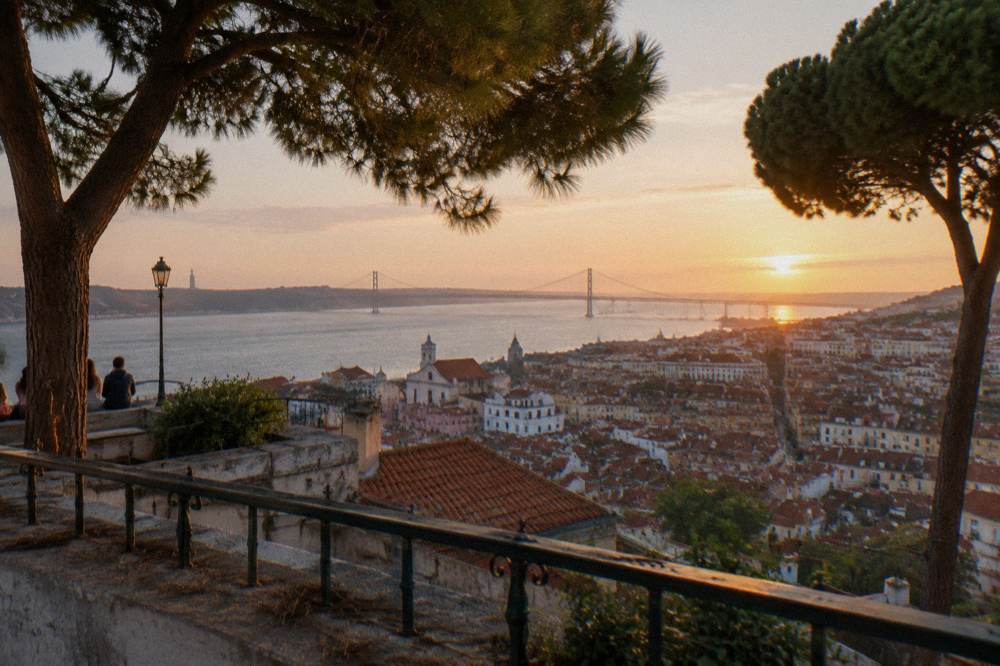
One more hill fact worth folding into the plan: the city's steepest public staircase is not in Alfama but on the route down from the Graca viewpoint, where the steps drop toward the Pantheon in long flights. Walk it downhill, never up, and the whole hill problem shrinks to something manageable.
Which Stops On The Route Cost Money, And Which Are Free?
Most of the classic route is free: Commerce Square, Rossio, Chiado's streets, the Largo do Carmo exterior, Alfama's lanes and the Portas do Sol and Graca viewpoints all cost nothing. The paid stops inside walking distance are the Museu do Fado at 5 EUR, the Cathedral's cloister, and, if you extend to Belem, Jeronimos Monastery at 18 EUR and Belem Tower at 15 EUR. A walker can spend a full rich day for under 10 EUR in tickets.
The free list is long enough that the self-guided approach has a real financial argument. Beyond the squares and viewpoints, the Cathedral's main nave is free to enter, the Alfama lanes themselves are the attraction, and the riverside promenade back from Belem is one of the city's best no-cost walks. If you want the fuller free-sightseeing picture, our guide to free things to do in Lisbon lists them by neighbourhood, including several along this exact route.
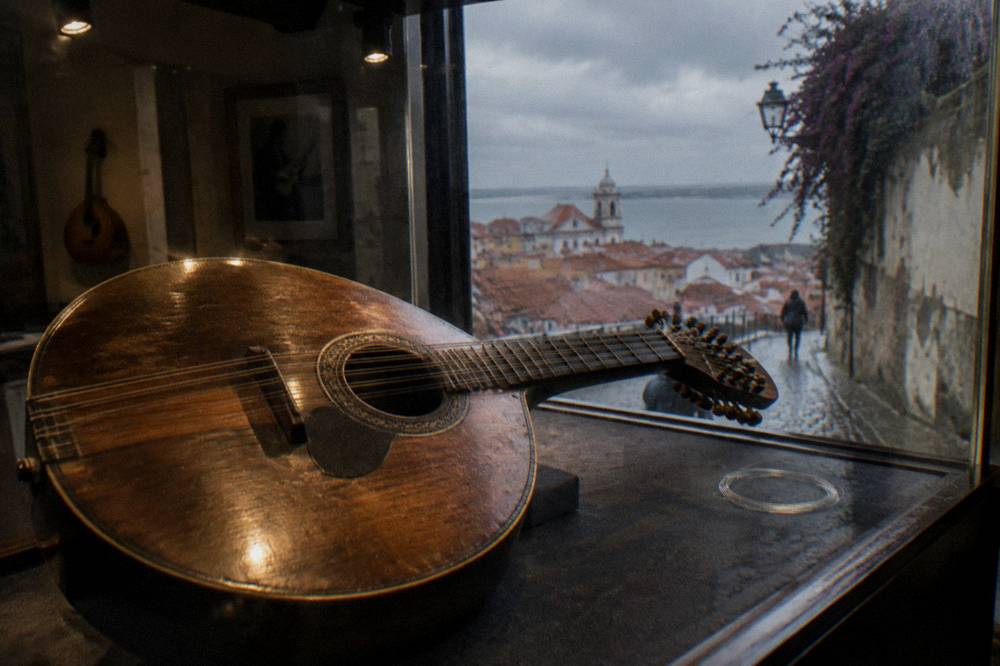
The paid stops reward choosing rather than collecting. The Museu do Fado, 5 EUR normal ticket, closed Mondays, sits inside the walk, in Alfama's edge near the river, and does the best job of any stop on the route of explaining the neighbourhood you are standing in; the official museum's visit page carries the current hours. Fado was inscribed by UNESCO in 2011, and the museum tells that story with recordings and instruments rather than dry panels. For evening plans, the shows in the city run 50 minutes to 2 hours, and the fado shows overview covers what a ticket buys.
| Stop | Entry cost | Notes for walkers |
|---|---|---|
| Commerce Square, Rossio, Chiado | Free | The flat spine of the route |
| Largo do Carmo ruins garden | Small fee | Check the gate, prices on site |
| Lisbon Cathedral nave | Free | Cloister is paid |
| Alfama lanes, Portas do Sol, Graca view | Free | The heart of the walk |
| Museu do Fado | 5 EUR | Closed Mondays, hours on the official page |
| Jeronimos Monastery (Belem extension) | 18 EUR adult | Closed Mondays, per the official ticket portal |
| Belem Tower (Belem extension) | 15 EUR adult | Same closures as Jeronimos |
The Belem extension deserves its own arithmetic. Jeronimos Monastery's cloister, 18 EUR for an adult and closed Mondays per the official monument page, is arguably the single finest interior in the Lisbon area, and the tower at 15 EUR is more impressive from outside than in. Two adults visiting both pay full price at each monument, against a combined walk-and-train day that costs 3.80 EUR in transit and a coffee. Our what to do in Belem piece splits the difference stop by stop.
Where Does The Self-Guided Plan Break Down?
A self-guided walk breaks down at three predictable points: when the hills compound late in the day, when queues eat the schedule, and when the buildings stay mute without context. None of these sink the plan, but each one marks the moment a guided walk, an e-bike or a food tour stops being a luxury and starts solving a specific problem you are actively having. If a food tour sounds like the fix you need, the guide to Lisbon dishes worth planning your day around shows which stops earn their spot between the sights.
The hill problem compounds. The route above hides about 150 metres of total climbing across five separate ascents, and by the third one, around the Cathedral, many walkers are negotiating with themselves about skipping the castle. This is precisely the failure the e-bike format exists to solve: the seven hills half-day electric bike tour from 24 EUR, rated 4.9 from 1,739 reviews, rides the same ridgelines, and its selling point is not speed but the absence of that negotiation.
The queue problem is real but bounded. The custard tart counter moves fast, the cathedral flows freely, and the genuine bottlenecks are in Belem, where a recent guest review of the small-group monastery walk notes that "although the line to enter Jeronimos was quite long, the visit was well worth it", a fair warning that timed planning beats hoping. The Museu do Fado rarely queues at all.
The context problem is the subtlest. Lisbon's lanes do not explain themselves, and a plaque-free street in Mouraria gives a solo walker nothing to work with, whereas a guide connects the great earthquake, the fado that grew in these alleys and the tiles overhead into one story. Guest reviews of the city's walks repeatedly single this out; one five-star review of the small-group city walk praises a guide who "explained the history in an informative, interesting and entertaining way". That is the product you cannot buy at a museum desk.
There is also a middle path that solves context and lunch in one move. A food and wine walk such as the three-hour small-group version from 70 EUR, rated 4.9 from 5,097 reviews, trades monuments for counters and taverns, and the format is laid out across the options in our walking tours cluster. Walkers who pair a morning self-guided loop with an afternoon food walk often report it as the best-structured day of their trip, since each half covers what the other cannot.
The decision, then, is not guided versus solo but which segments to hand over. A common split: self-guide the flat Baixa and Chiado spine in the morning when energy is high and context is easy, then join a guided walk for the Alfama tangle, or hand over the whole day and let someone else carry the map, the history and the lunch reservation.
Common Questions About Self-Guided Walking Tours
Can You See Lisbon On Foot Without A Tour?
Yes. The Baixa, Chiado and Alfama loop covers the historic core in about 4 to 5 hours, and every viewpoint and square on it is free. The Museu do Fado at 5 EUR is the only paid stop most walkers add. A tour adds context, not access.
How Hilly Is The Walking Route Really?
Roughly 150 metres of total climbing, concentrated in the Chiado rise and the Alfama ascent. With the Gloria, Bica and Lavra funiculars and the Santa Justa lift closed to passengers and the Graca funicular running again, plan around the hills or use the 28E tram and metro elevators to skip the worst climbs, and check Carris for current status.
What Does A Guided Walking Tour Cost In Lisbon?
The three-hour Rossio, Chiado and Alfama walk runs from 22 EUR per person and includes a meal, while the small-group Best of Lisbon walk starts at 19 EUR. Longer food and wine walks run from about 63 to 104 EUR depending on format and tastings.
Is A Self-Guided Walk Safe For Solo Travellers?
The core route is busy through daylight hours and generally relaxed. Standard petty-theft awareness applies on crowded trams and in the busiest squares: keep bags closed and in front, and carry only what you need for the day.
Should I Walk Or Take An E-Bike Tour?
Walk if you want tilework, staircases and spontaneity; ride if the hills are a dealbreaker. E-bike tours of the hills, Alfama and Mouraria start from 25 EUR for three hours, which is little more than the price of the tram rides you would otherwise use to escape the climbs.
Can I Add Belem To A Self-Guided Walking Day?
Yes, by train along the river from the central stations. Belem is flat and compact, the riverside promenade is free, and the two big monuments, Jeronimos at 18 EUR and the Tower at 15 EUR, are closed Mondays, so plan the extension for any other day.