Is It Safe For Americans To Travel To Lisbon Right Now?
A plain answer for US visitors on safety in Lisbon: entry rules, pickpocket awareness, transport, neighbourhoods and how guided tours keep you oriented.

Is It Safe For Americans To Travel To Lisbon Right Now?
Yes, in the practical sense that matters to travellers. Portugal is a stable European Union country with a large year-round tourism industry, and the safety issues US visitors actually encounter in Lisbon are petty theft and uneven cobblestones, not violent crime. The European Union's Entry/Exit System is now in operation at border control, ETIAS travel authorisation is not yet required for Americans, and common-sense habits cover the rest. With the safety question answered, the practical planning begins, and our Lisbon travel guide covering neighbourhoods, transport and planning walks you through the decisions that actually shape your trip.
That answer comes with an honest caveat: no responsible page can promise you a risk-free trip, and this one will not. What we can do is separate the real, documented concerns from the imagined ones. American travellers tend to arrive with three questions. Do I need a visa or a new permit? Will I be robbed? And is the city walkable and safe at night? The first has a clear official answer, the second is about awareness rather than danger, and the third is largely a question of geography, because Lisbon's hills and alleys reward people who know where they are going.
Portugal receives millions of foreign visitors a year, and Lisbon's old quarters, its riverside and its day-trip towns are all built around that flow. The infrastructure you interact with, trains, trams, museums, ticketing systems, is designed for people who do not speak Portuguese and are visiting for the first time. That does not make the city risk-free, but it does make it legible, and legibility is most of what travel safety feels like in practice.
This article walks through the entry paperwork first, because that is the one part that can genuinely stop a trip before it starts. Then it covers pickpocket awareness, public transport, the hills and funicular situation, neighbourhoods after dark, health basics, and finally how a guided format, from the three-hour small-group walk to the two-hour tuk tuk loop, quietly solves several of these problems at once by handing you a local who knows the streets. Along the way you will find two comparisons built from the verified tour listings on this site, so the safety advice ends in something you can actually book with confidence.
The short version for a first-time visitor planning a week: bring your passport, keep your phone out of your back pocket on Tram 28, book a walking tour or a tuk tuk loop for day one to get your bearings, and relax. Everything below expands on that, with the official sources named where a rule comes from one.
What Do US Visitors Need To Enter Portugal?
Americans do not need a visa for tourist stays of up to 90 days in Portugal, and the ETIAS travel authorisation system is not yet operational, so US citizens cannot apply for it yet. The EU Entry/Exit System, which records biometrics at the border, is in operation, so expect a fingerprint and photo scan at entry. Your passport should be valid for at least six months beyond your travel dates as standard practice.
The entry picture changed in two stages, and it is worth knowing which stage applies to you. The Entry/Exit System, known as EES, replaced manual passport stamping at the EU's external borders and is fully deployed across member states, as the EU agency that operates it, eu-LISA, confirms on its official news page. In practical terms this means an automated kiosk or an officer scans your fingerprints and takes your photograph on first entry. It adds a few minutes at the border and nothing else; there is no form to fill in beforehand and no fee for tourists.
The EES deployment notice is worth a skim if you like knowing exactly what will happen at the desk. The second stage, ETIAS, is the one that will eventually require visa-exempt travellers, including Americans, to apply online for a travel authorisation before departure. It is not yet accepting applications. The European Commission's home affairs page states plainly that no applications can be submitted yet and that the exact start date will be announced several months in advance, so if a third-party site offers to sell you an ETIAS today, that is a service you do not need yet. The Commission's smart borders page is the authority on this, and it supersedes every blog post, including parts of older ones.
| Requirement | Applies to US citizens now | Source of the rule |
|---|---|---|
| Tourist visa | Not needed, up to 90 days in the Schengen area | EU visa-free travel rules |
| ETIAS authorisation | Not yet operational, no applications accepted | European Commission smart borders page |
| EES border registration | Yes, fingerprint and photo scan at entry | eu-LISA deployment notice |
| Passport validity | Standard practice is six months beyond travel | US travel guidance |
None of this is frightening, but it is date-sensitive in a way most safety questions are not, and it is the single most common source of wasted money before a trip: third-party sites charging for documents that either do not exist yet or are free from the official source. Bookmark the Commission page if your trip is still months away and check it once before you fly.
On arrival, Lisbon's airport is small by major-capital standards and the connection to the centre is simple. The Metro's red line runs from the airport on a standard single ticket of 1.90 EUR plus 0.50 EUR for the rechargeable card on first use, and licensed taxis operate on fixed published fares to central zones. There is no safety question here that a normal city airport poses, and the usual advice about unlicensed drivers applies the same as anywhere: use the rank or a licensed operator.
Is Pickpocketing A Real Concern In Lisbon?
Yes, opportunistic pickpocketing is the most commonly reported petty crime affecting tourists, concentrated on Tram 28, public transport, and the crowded streets of Alfama and Baixa, according to local awareness guides. It is a crime of opportunity rather than confrontation: bags held loosely and phones in back pockets are the usual targets. Simple habits, a zipped front bag and awareness in crowds, prevent nearly all of it.
This site's hard rule against printing crime statistics is actually a good discipline for the reader too, because raw numbers without context scare people more than they inform them. What the local awareness pages consistently report is a pattern, not a war zone. Crowded trams, queue lines at major monuments, busy viewpoints and night-time party streets are where phones and wallets go missing, usually without the victim noticing until later. Thefts with any violence are rare enough that they are not part of the standard visitor advisory.
The classic scenario is Tram 28, the heritage route that grinds from Martim Moniz through the Alfama hills, packed shoulder to shoulder with tourists and locals. It is a wonderful ride and you should take it, just not with a backpack on your back and a phone in a side pocket. Ride with your bag in front, between your arms, ideally against a corner of the tram rather than the middle of the crush. The same logic applies at the Praça do Comércio, on the funicular routes if you use them, and in the evening crowds of Bairro Alto, where the streets fill and dim at the same time.
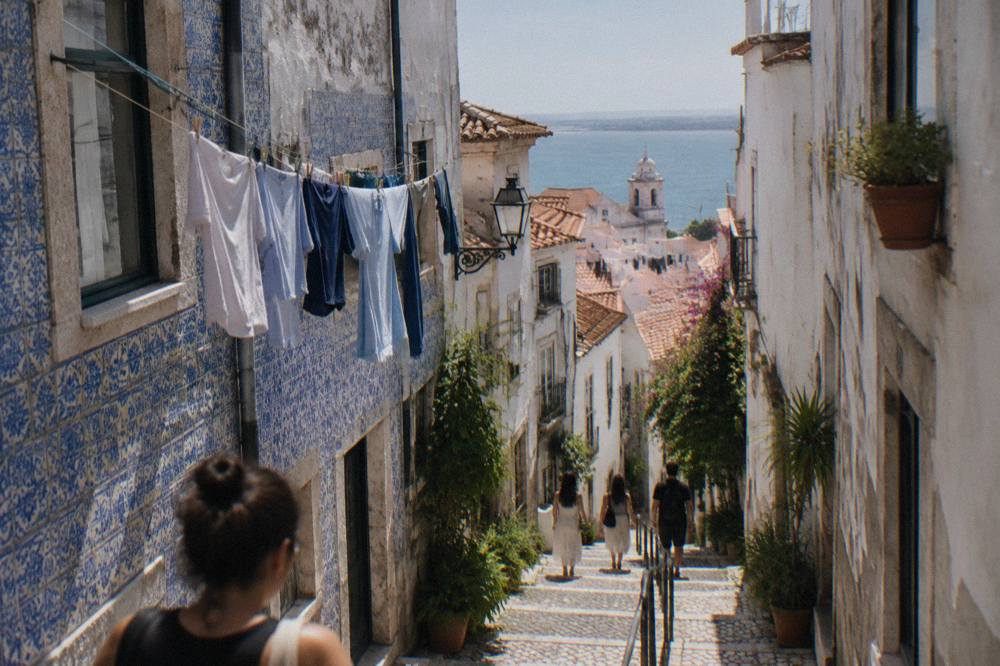
A few habits cover almost everything. Keep the day's cash in a front pocket and the rest in the hotel safe. Wear your bag across your body on the side away from the kerb and the crowd. Do not put your phone down on a cafe table in a busy square. If someone jostles you in a crowd, treat it as the moment to check your zips, because that is precisely when the professional operators work. None of this is Lisbon-specific; it is the same toolkit you would use in Barcelona, Rome or New Orleans.
One local nuance worth knowing: card payment is accepted almost everywhere tourists go, which means you can carry very little cash at all. The fewer things in your pockets, the fewer things there are to lose. And if the worst happens, file a report at a police station, because your travel insurance will want the report number. The EU-wide emergency number works in Portugal from any phone, including one without a local SIM.
Still figuring out how to spend your first day in the city with your bearings intact? A small-group walk can be booked with free cancellation flagged on the listing, with the window shown on the booking page.
Is Public Transport Safe And Easy To Use?
Yes. Lisbon's public transport is safe, frequent and tourist-friendly, with a single ticket at 1.90 EUR and a 24-hour Carris and Metro pass at 7.25 EUR. The main caveats are crowding and pickpockets on the heritage trams, and the fact that three of the four historic funiculars and the Santa Justa lift are closed to passengers, so check Carris for current status.
The transport system rewards a small amount of preparation. Buy a rechargeable card at any Metro station, load it with a day pass or single tickets, and tap in. The Metro is clean, modern and considered safe at normal operating hours, and its four lines connect the airport, the main stations and the riverside. Buses and trams share the same card system. The one figure that surprises visitors is the on-board tram ticket at 3.30 EUR, nearly double the pre-paid fare, which is the system nudging you toward the card.
The heritage trams deserve their own paragraph because they are both the city's best experience and its most crowded. Tram 28 is the famous one, and it is exactly as packed as its reputation suggests in high season. There is also a service note worth knowing: Carris has run modified tram service in the Estrela area at points during the year, with trams operating part of the route and buses covering the rest, so check the operator's notices before you plan a full end-to-end ride. Our Tram 28 route and riding guide covers the practicalities in detail, including where to board for a seat.
The funicular situation is a genuine change from the Lisbon of older guidebooks. The Gloria, Bica and Lavra funiculars and the Santa Justa lift are closed to passengers, while the Graca funicular runs again; Carris publishes the current status, and the hills those lifts served are still perfectly walkable, just steeply so. If knee-saving elevation is the goal, a private tuk tuk tour is the practical substitute, and the two-hour tuk tuk loop along the Tram 28 route through the old town covers exactly the hills the closed lifts used to serve, with a driver doing the climbing for you.
For day trips, the same card system extends to the urban trains: the run from Rossio to Sintra takes about 40 minutes and departs roughly every 20 minutes, and the Cascais line runs along the river from Cais do Sodre. These are ordinary commuter trains, used by thousands of locals daily, and the safety calculus is the same as any suburban rail line: watch your things at the stations, less so on the train.
Are Lisbon's Neighbourhoods Safe At Night?
Yes, the central neighbourhoods visitors stay in, Baixa, Chiado, Bairro Alto, Alfama and Principe Real, are generally safe to walk at night, with well-lit main streets and constant foot traffic until late. The adjustments are about tone rather than territory: pickpocket awareness in evening crowds, moderate drinking streets that get rowdy, and poorly lit side lanes in the old quarters where a main street is the better choice. An evening walk through Alfama or Bairro Alto pairs naturally with fado, and our guide to where locals actually hear fado in Lisbon covers the neighbourhood tascas and houses worth seeking out.
Lisbon's nightlife geography explains most of this. Bairro Alto is the bar quarter, tiny streets filling with people standing outside bars until the small hours of Friday and Saturday. It is festive rather than dangerous, but a dense drunk crowd is where phones go missing, so the front-pocket rule applies twice over. Alfama at night is quieter and more atmospheric, candle-lit fado restaurants down lanes that confuse GPS, and the honest advice is that the lanes are safe but disorienting, and disorientation is what makes people feel unsafe. Cais do Sodre's Pink Street and the riverside strip are loud and central with constant taxi and rideshare traffic. Other pages covering the same trip are gathered on Lisbon Portugal Tours.
The areas genuinely worth a second thought are the ones no visitor itinerary touches anyway, the outer peripheral districts with no attractions, and the standard big-city rule covers them: there is no reason to go, so do not. Within the tourist perimeter, the streets that feel sketchiest are simply empty ones, and the fix is to walk one block over to a street with a cafe or a bus line on it.
Two practical notes for evening plans. Fado shows, which run 50 minutes to two hours on the listings in this site's roster, typically end late enough that you walk home through exactly these streets, and the fado houses cluster in Alfama and Bairro Alto, both well trafficked at that hour. And the riverside promenade between Cais do Sodre and Belem is a wide, lit, popular walk that families use at night without a second thought; it is one of the city's most comfortable after-dark spaces. For a deeper look at the evening culture, our piece on whether a fado night is worth it covers what the shows are actually like.
Do You Need To Worry About Health, Water Or Food?
No special precautions are needed. Tap water is safe to drink in Lisbon, food hygiene standards are those of the EU, and no vaccinations beyond routine ones are advised for Portugal. The realistic health concerns are sun and heat in summer, uneven pavement underfoot, and the steep hills, which matter more to visitors with mobility or joint issues than any disease does.
Portugal is a high-income EU country with a modern health system, and pharmacies, marked with a green cross, are ubiquitous and staffed by people who routinely deal with tourists. As a non-EU visitor you will pay for any care you receive, which is the reason travel insurance exists, and US health plans generally do not cover you abroad, so a basic policy with medical coverage is the one genuinely recommended purchase before the trip. The EU-wide emergency number connects to ambulance, police and fire from any phone.
The physical environment deserves more respect than the medical one. Lisbon's calçada, the wavy cobblestone paving, is beautiful and treacherous in equal measure, especially wet or in smooth-soled shoes. Broken and sprained ankles from cobbles and missed steps are a real category of tourist injury here. Wear shoes with grip, watch your feet on downhill lanes, and treat staircases in old buildings, including in hotels, as genuinely steep rather than decorative. The hills themselves are a workout; visitors who overestimate their day-one walking stamina are common, which is another quiet argument for the e-bike and tuk tuk formats that exist precisely to move people up these slopes without the sweat.
Food and drink safety is a non-issue by US standards. Raw and cooked dishes, market food, the custard tarts at about 1.50 EUR each at the famous Belem bakery, tap water in restaurants, all fine. The one food-adjacent caution is alcohol, cheap, strong and served in sociable quantities, particularly on night-time food and wine walks; the listings on this site include a three-hour food and wine small-group walk from 70 EUR per person where the pours are generous by design. Pace yourself and the evening stays pleasant.
How Do Guided Tours Help You Stay Safe And Oriented?
A guided tour solves the orientation problem on day one: a licensed local guide gets you through the confusing lanes of the old quarters, shows you which streets connect, and removes the map-staring that marks you as a target. The small-group walk from 32.88 EUR, the three-hour best-of walk with a meal included from 19 EUR, and a private tuk tuk loop are the formats that do this most directly.
The safety benefit of a tour is indirect but real. Most petty theft happens when a traveller is distracted, standing still in a crowd, staring at a phone map, hesitating at a junction with a wallet out for a tip. A guide eliminates those moments for three or four hours while simultaneously teaching you the city's logic: where the main axes run, which squares connect, how the hills stack up. After a single guided morning, most visitors navigate the centre confidently on their own, which is the whole point.
| Format | What it does for orientation | Listing details |
|---|---|---|
| Small-group walk, 3 hours | Covers the central quarters with a licensed guide, small group | From 32.88 EUR, rated 4.9 from 263 reviews |
| Best-of walk with meal, 3 to 4 hours | Full centre overview plus a included meal stop | From 19 EUR, rated 4.9 from 5542 reviews |
| Tuk tuk on the Tram 28 route, 2 hours | Covers the old-town hills without the climbing | From 80 EUR, rated 5.0 from 224 reviews |
| Riverside e-bike tour, 3 hours | Flat riverside corridor to Belem, easy riding | From 40 EUR, rated 4.8 from 400 reviews |
The featured listing on this page, the Lisbon small-group walking tour, is a good example of the category: three hours, a small group cap, and a format built around the central streets a first-timer needs to learn. For a wider comparison of formats and operators, the Lisbon walking tours cluster gathers the guided options in one place, and our longer piece on whether a walking tour is worth it in Lisbon works through the value question.
One more orientation tool worth naming: the e-bike tours. The city-highlights e-bike tour from 29 EUR and the seven-hills half-day e-bike tour from 24 EUR both exist because Lisbon's topography defeats some walkers, and an electric bike flattens it. A review of the highlights tour on the live listing praises the guide for making everyone feel welcome and the bikes being in good working order, which is the practical reassurance that matters: functioning equipment and a guide watching the road for you. As the publisher behind this site, we compared these listings on price, duration, group size and rating, and the pattern is consistent, every format pairs a local guide with a defined route, which is exactly the combination that keeps a first-day visitor from getting lost.
What Should Americans Know About Emergencies And Money?
Dial the EU-wide emergency number for police, ambulance or fire from any phone in Portugal, including a US phone without a local SIM. Travel insurance that covers medical care abroad is recommended since US plans generally do not pay for foreign treatment. Cards are accepted nearly everywhere tourists go, so carrying minimal cash reduces theft exposure without inconvenience.
The emergency system is uniform across the EU and answers in English. For non-emergencies, tourist-oriented police posts exist in the central quarters during high season, and any hotel or guide will point you to the nearest one. Pharmacies handle minor illness and can advise on clinic visits; look for the green cross and the word farmacia.
On money, the practical safety play is simply to need less of it. Card terminals are everywhere, including small cafes and market stalls, and contactless payment is the norm. Carry one card, keep a backup in the hotel safe, and skip the large cash withdrawals. If a card is skimmed or lost, US issuers handle it the same as at home, which is why the true financial risk of a Lisbon trip is lower than it feels on the flight over.
Finally, the paperwork redundancy that saves trips: a photo of your passport stored offline, a printed hotel address for the taxi, and your insurance policy number in your wallet. None of these will likely be used. All of them take five minutes to prepare, and together they answer the question this article opened with better than any statistic could. Portugal is a place where preparation is cheap and trouble is rare, and Americans who arrive with a booked walking tour for day one and a zipped bag for Tram 28 have handled essentially the entire risk profile.

Common Questions About Lisbon Safety For Americans
Is It Safe For Americans To Travel To Lisbon Right Now?
Yes, in practical terms. Lisbon's risks to visitors are petty theft, uneven cobbles and steep hills rather than violent crime. The EU Entry/Exit System is in operation at the border, ETIAS is not yet required for Americans, and ordinary awareness on crowded trams covers most of the rest.
Do Americans need a visa or ETIAS for Portugal?
No visa is needed for tourist stays up to 90 days. ETIAS is not yet operational and no applications are accepted yet, so nothing to arrange for now. EES biometric registration, fingerprints and a photo, happens at the border itself.
Where is pickpocketing most likely in Lisbon?
Crowded heritage trams, especially Tram 28, busy transport stations, packed viewpoints and nightlife streets in Alfama and Baixa. Keep bags zipped and in front, phones out of back pockets, and minimal cash on you.
Is Lisbon safe to walk around at night?
The central visitor neighbourhoods are generally fine after dark, with busy, lit main streets. Prefer main streets over empty lanes in the old quarters, and keep the same pickpocket habits in late-night bar crowds.
Is the tap water safe to drink in Lisbon?
Yes, tap water is safe throughout the city. No special vaccinations are advised for Portugal, and food hygiene follows EU standards.
What is the emergency number in Portugal?
The EU-wide emergency number reaches police, ambulance and fire and answers in English from any phone, including a foreign handset without a local SIM.